
In this article9 sections
Key takeaways
- Source order is the dominant pattern. Grok cited 80.0% of first-listed sources and 22.6% of sources at position 21 or later; Claude cited 53.3% and 17.9%.
- A modified-date signal is associated with citation on Grok, not on Claude. Grok cited 28.0% of fetched pages carrying one and 20.0% without; Claude cited 39.9% and 39.2%.
- The signal is worth most near the top of the list. Among pages Grok had listed in its first five, 81.0% with a modified date were cited against 58.0% without.
- Recency inside 3 months is not associated with citation. A three-month date appeared on 22.1% of Grok's cited pages and 18.5% of its never-cited pages; on Claude, 24.1% and 24.4%.
- Old pages are still cited. A date older than 24 months appeared on 9.5% of Claude's cited pages and 3.5% of Grok's.
- The research is from one games-industry project that has a special interest in Claude and Grok; 18 prompts, five runs, both engines. Every table shows an observed association, not the result of changing pages.
How often does an engine cite the source it lists first?
The first-listed source is the most likely to be cited on both engines. Grok cited 72 of the 90 sources it listed first, 80.0%, and 1,000 of the 4,417 sources it listed at position 21 or later, 22.6%. Claude cited 48 of its 90 first-listed sources, 53.3%, and 7 of the 39 it listed past position 20, 17.9%.
| Position in the recorded source list | Grok: cited in that answer | Claude: cited in that answer |
|---|---|---|
| 1 | 80.0% (72/90) | 53.3% (48/90) |
| 2-3 | 67.8% (122/180) | 45.6% (82/180) |
| 4-5 | 58.3% (105/180) | 32.8% (59/180) |
| 6-10 | 38.7% (174/450) | 28.5% (111/389) |
| 11-20 | 35.2% (317/900) | 31.1% (94/302) |
| 21 or later | 22.6% (1,000/4,417) | 17.9% (7/39) |
The table shows same-answer URL matches from the CiteSurge retrieval study, 21 August to 9 September 2026; repeated appearances count separately.

Grok's curve is steepest in the first five positions: the share falls from four in five at position 1 to under two in five at positions 6 to 10. Claude's share drops over the same positions on a smaller sample, and its curve is not uniformly downward.
The two engines' source lists are very different in length. Grok recorded a median of 65 sources per answer and Claude 13, which is why Claude's final row holds 39 records against Grok's 4,417. Position means order in the recorded source list; our data does not show whether that order is the engine's relevance ranking.
Lower positions still provide many citations in total. Grok's position-21-or-later group contains 1,000 cited records, more than any other row. Earlier positions carry a higher share of citations, not a larger number of them.
Does a modified-date signal go with being cited?
On Grok the answer is yes: 28.0% of fetched pages carrying a detected modified date were cited at least once, against 20.0% of pages without one. On Claude the answer is no: 39.9% against 39.2%.
A modified-date signal means a parseable modified date from JSON-LD, a supported meta tag, or visible updated-date text. The question in this section is whether the page declares one at all; how old the date is comes next.
| Engine | With a detected modified-date signal | Without |
|---|---|---|
| Grok | 28.0% (188/672) | 20.0% (241/1,207) |
| Claude | 39.9% (81/203) | 39.2% (56/143) |
The table shows URL-level shares from the CiteSurge retrieval study; each fetched URL counts once per engine, and cited means cited at least once during the study window.
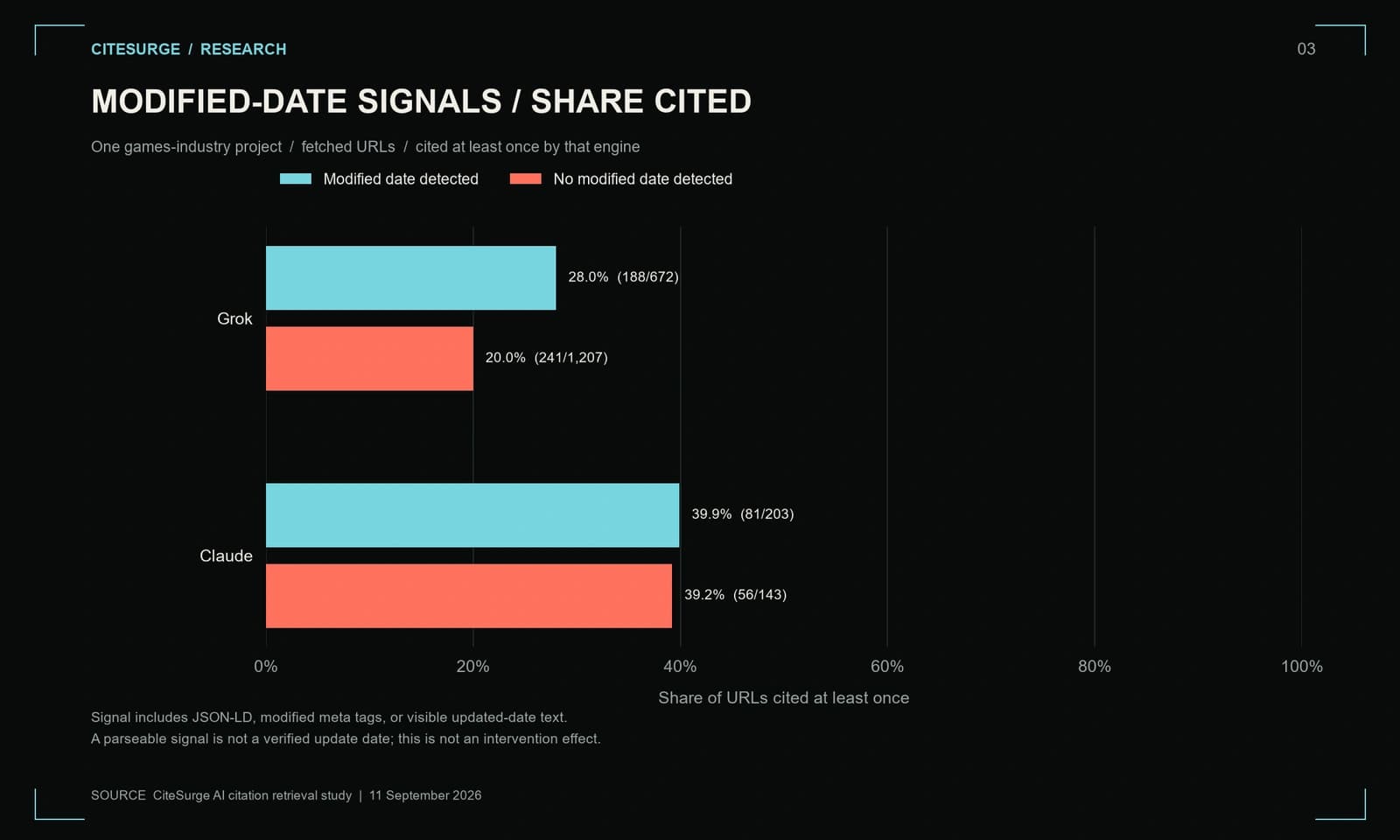
Grok's share is 8 percentage points higher with the signal. Claude's two shares are within a point of each other. A parseable date shows that the page declares one; it does not verify that the page changed on that date, and pages dated after the observation stay in this comparison even though they are unknown for age.
Where the signal counts: pages already near the top of the list
The gap is widest at the top of Grok's list. Among fetched Grok pages whose earliest recorded position was 1 to 5, 81.0% of those with a modified-date signal were cited and 58.0% without, a gap of 23 percentage points. Past position 20 the gap is under 2 percentage points.
| Grok URL's earliest recorded position | With a detected modified-date signal | Without |
|---|---|---|
| 1-5 | 81.0% (64/79) | 58.0% (51/88) |
| 6-20 | 37.7% (55/146) | 30.7% (67/218) |
| 21 or later | 15.4% (69/447) | 13.7% (123/901) |
The table shows URL-level earliest position against citation at least once across runs, from the CiteSurge retrieval study; position and citation can come from different answers.

Pages that appeared in more answers had more chances both to reach an early position and to be cited, and the table is not adjusted for how often each URL appeared. Claude's gaps changed direction between position groups on small counts, so its near-equal overall shares are the only Claude figure worth quoting.
A modified-date signal is often a marker of maintained documentation and other useful content. The groups compare pages that carry the signal with pages that do not; they do not isolate what adding the signal would do.
Does recency matter? Inside a year on Grok, not inside 3 months anywhere
Recency is a weak signal on Grok and no signal on Claude. A date inside 12 months appeared on 46.6% of Grok's cited pages and 38.8% of its never-cited pages; inside 3 months, 22.1% and 18.5%. Claude's 12-month shares were 46.0% and 43.1%, and its 3-month shares 24.1% and 24.4%.
| Engine | Date measure | Cited pages | Never-cited pages |
|---|---|---|---|
| Claude | Detected date within 12 months | 46.0% (63/137) | 43.1% (90/209) |
| Claude | Detected date within 3 months | 24.1% (33/137) | 24.4% (51/209) |
| Grok | Detected date within 12 months | 46.6% (200/429) | 38.8% (562/1,450) |
| Grok | Detected date within 6 months | 35.9% (154/429) | 27.2% (395/1,450) |
| Grok | Detected date within 3 months | 22.1% (95/429) | 18.5% (268/1,450) |
| Claude | Detected date older than 24 months | 9.5% (13/137) | 8.1% (17/209) |
| Grok | Detected date older than 24 months | 3.5% (15/429) | 7.5% (109/1,450) |
The table shows shares of all successfully fetched URLs in each engine's group, including unknown dates, from the CiteSurge retrieval study with post-observation dates excluded from age.

Grok's cited group is 8 to 9 percentage points more likely to carry a 6-month or 12-month date. Claude's 12-month gap is under 3 percentage points and its 3-month shares are the same. On both engines the 3-month window, the one that quarterly-refresh advice is built on, separates nothing.
Each recent-date share includes pages with no usable date in its denominator. A page with no usable date cannot enter a recent-date row, so each row describes the whole fetched group rather than the age distribution of dated pages alone.
Can a page with an older date still be cited?
Yes, older pages are cited on both engines. A date older than 24 months appeared on 13 of Claude's 137 fetched cited pages, 9.5%, and on 15 of Grok's 429, 3.5%. An older date on its own did not keep a page out of the cited group, and it does not show that the content was out of date.
What content teams can do with this
The first question is whether your page is in the engine's source list at all, and where in it. In our data, position in the list separated cited from uncited sources more sharply than any date measure did.
A modified date in JSON-LD is worth declaring when the content changed, and worth representing accurately. On Grok, pages that declared one were cited more often, and most so when the page was already in the first five sources. On Claude the declaration made no difference, so it costs nothing there.
Timestamp-only refreshes are not supported by anything in these tables. A date inside 3 months went with no citation difference on either engine. Update a page when a fact in it changes and record the date when you do.
Claude and Grok are different systems. Their source lists differ in length, their date patterns differ, and a plan built for one is not a plan for the other. Our platform guides cover the individual answer surfaces.
The next study is a before-and-after: record substantive page changes and the citations that follow, alongside comparable pages left unchanged. Our AI answer monitoring capability is the measurement side of that work.
How we ran the study
Our dataset is one games-industry client's 18 prompts, run on both engines. Each prompt ran once per engine on each of five dates: 21 August, 3 September, 4 September, 6 September, and 9 September 2026. A check against the original observation records confirmed that the planned prompt text stayed unchanged across runs.
Terms used in this article
- Recorded source list means the ordered list of URLs an engine reported alongside its answer. Position means order in that list.
- Cited means the URL matched a saved citation record for the same answer.
- Never cited means no such match for that engine during the study window. It does not mean the engine never read or used the page.
- Detected date means a date parsed from the page's markup or visible text on 11 September 2026. Modified dates took priority; publication dates were used as fallback. A detected date is not a history of edits.
- Modified-date signal means a parseable modified date from JSON-LD, a supported meta tag, or visible updated-date text, regardless of age.
Matching sources to citations
Each source-list URL is matched to the citation records of the same answer. The export holds 7,397 source-list records across 2,515 pages; a record is one URL in one answer's list, and repeated appearances count separately. The position table uses those same-answer matches. The date comparisons count each URL once per engine and ask whether that engine cited it at least once across the five runs. We checked the saved raw responses against the study export: source order and citation flags matched for all 180 answers.
Missing dates and fetch selection
The date comparisons include successfully fetched pages only. We measured age against the URL's last recorded observation day for that engine; any detected date later than that day was treated as unknown for age and left in the fetched totals.
| Engine and citation group | Eligible URLs | Successfully fetched | Excluded from date analysis | Usable date for age |
|---|---|---|---|---|
| Claude, cited | 150 | 137 | 13 | 81 |
| Claude, never cited | 258 | 209 | 49 | 124 |
| Grok, cited | 494 | 429 | 65 | 250 |
| Grok, never cited | 1,759 | 1,450 | 309 | 783 |
The table is drawn from the frozen observation and page-date exports; exclusions include unsuccessful, skipped, or unavailable fetch results, and usable dates exclude dates later than the reference observation day.
Post-reference dates are present on 25 fetched Claude URLs and 143 fetched Grok URLs. Same-day dates were retained because the export records calendar days, not timestamps, and cannot order events within a day.
One project and two collection methods
The recorded models are Claude Haiku 4.5 and Grok 4.3. Claude contributed 70 CLI answers and 20 API answers; Grok used the Responses API. Lists combine results from multiple searches. The Claude CLI path retains the first occurrence of each URL, while the API lists can retain repeated entries. The collection differences are part of the sample.
130 successfully fetched URLs are in both engine groups. Shared URLs are counted separately within each engine, and citation status is engine-specific.
What this study cannot tell you
The study does not show what happens when you update a page. Nothing was changed and measured; every table compares pages as they were found.
The study does not show that source order is a relevance ranking. Position is order in the recorded list, and we did not test what determines that order.
The study does not show what an engine saw. Pages were fetched on 11 September, after the answers were generated, so a later edit can make a page look newer than it was at citation time. Cited pages may be edited more often than uncited ones, which would bias the date tables toward the cited group.
The study does not show how the web at large behaves. One project, one industry, 18 prompts, and five runs mean the same prompts, URLs, and domains recur, so the observations are not independent and the shares should not be generalized beyond this sample. The collection paths for the two engines also differ, so the tables are not a controlled comparison of Claude against Grok.
An absent detected date does not show an old or unmaintained page. An absent date means our extraction found no usable date on that fetch.
Frequently asked questions
Does content freshness affect AI citations?
Freshness is a modest signal on Grok and no signal on Claude in this study. A date inside 12 months appeared on 46.6% of Grok's cited pages and 38.8% of its never-cited pages. Claude's shares were 46.0% and 43.1%. A date inside 3 months made no difference on either engine.
Does adding dateModified to schema increase citations?
The study shows an association, not the result of adding the field. Pages carrying a modified-date signal were cited more often on Grok, 28.0% against 20.0%, and equally on Claude, 39.9% against 39.2%. Declare it when the content changed.
Do AI engines cite old pages?
Yes, old pages are cited. 9.5% of the pages Claude cited and 3.5% of the pages Grok cited carried a detected date older than 24 months.
What matters more than freshness for AI citations?
Where the engine lists the source is the stronger pattern. Grok cited 80.0% of first-listed sources and 22.6% at position 21 or later; Claude cited 53.3% and 17.9%.
How was "cited" defined?
A source is cited when the same answer's saved citation records include its URL. Never cited means no match for that engine across the five runs; it does not mean the engine never read the page.
Study reference
The source is CiteSurge, AI citation retrieval study, 11 September 2026: original first-party research covering recorded Claude and Grok source lists and citations from 21 August to 9 September 2026. Aggregate definitions and tables are provided above. Client identities, source domains, prompts, and answer text remain private.
How to cite: CiteSurge (2026). Does content freshness affect AI citations? What 180 Claude and Grok answers showed. https://citesurge.com/insights/does-content-freshness-affect-ai-citations. Published 11 September 2026.
CiteSurge shows you where your pages sit in the answers your buyers see. Contact us to start.
References
- AI citation retrieval study: method, definitions and aggregate tables · CiteSurge · reviewed